

-
 EBOLA DEATH INTENSIFIES KENYA’S SURVEILLANCE CRACKDOWN
-
 CIGGIE JOHNSON DEVASTATED BY 12-YEAR PATERNITY DNA SHOCK
-
 SIFUNA LANDS NEW PARTY FOR 2027 RACE
-
 MAN CITY VERDICT TRIGGERS FALLOUT
-
 CR7 ERA HANGS IN BALANCE AS RONALDO LEAVES PORTUGAL IN UNCERTAINTY
-
 CHIVAYO DIES IN HELICOPTER CRASH
-
 DANGOTE SHRUGS OFF LAMU PROTESTS, BRACES FOR COURT BATTLE
-
 ATWOLI CALLS FOR UHURU'S ARREST OVER RAILA 2022 CLAIMS
-
 Karura race draws more than 1,000 runners ahead of Nairobi Marathon
EBOLA DEATH INTENSIFIES KENYA’S SURVEILLANCE CRACKDOWN
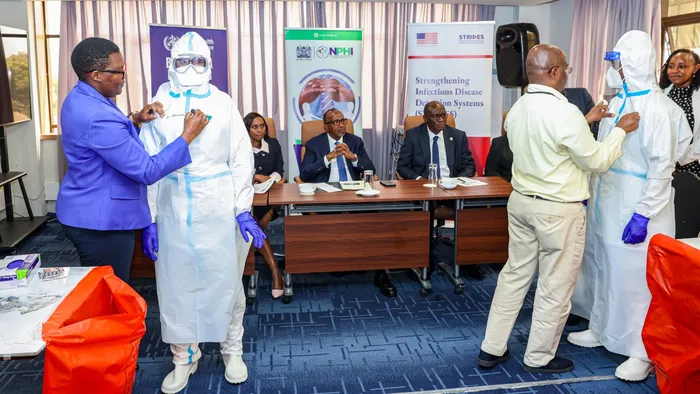
Kenya has intensified surveillance, contact tracing and border screening after recording its first Ebola death, with health authorities moving to tighten the country’s preparedness despite insisting that there is no outbreak locally.
The Kenyan patient, who had lived in the Democratic Republic of Congo (DRC) for several years, died in Nairobi on October 6 after arriving in the country from Uganda. Health officials said he had fallen ill about a month earlier while in the DRC, which is battling a major outbreak of the Bundibugyo strain of Ebola.
The patient travelled overland from the DRC through Uganda before flying to Nairobi on Jambojet Flight 8523 from Entebbe on October 3. After arriving at Jomo Kenyatta International Airport, he was taken to hospital by a relative and a friend, isolated and later confirmed to have Ebola.
His death has triggered heightened concern over how he managed to travel through several locations while reportedly ill, prompting questions about the effectiveness of screening at regional borders and airports.
Africa Centres for Disease Control and Prevention Director-General Jean Kaseya said the patient had travelled from Buta in northern DRC to Kisangani, then flew to Beni before travelling by road into Uganda and eventually taking a flight to Nairobi.
“We know that he left Buta, a city in [northern] DR Congo, to drive to Kisangani. And from Kisangani, he took a flight to Beni. From Beni, he drove to Uganda. And from Uganda, he took a flight to Nairobi,” Kaseya said.
“What are symptoms he was presenting? Why was he not detected?” he added.
Kenyan health authorities have since stepped up efforts to identify people who may have come into contact with the patient. Ten primary contacts have been placed under quarantine at the National Police Service Hospital in Nairobi, while health teams continue efforts to trace other contacts.
Authorities are also tracking 23 passengers and four crew members who travelled on the same flight as the patient.
Director-General for Health Dr Patrick Amoth said the government was moving to strengthen the national response system, with contact tracing, surveillance at points of entry and readiness of isolation and treatment facilities placed at the centre of the operation.
“Our priority is to move with speed, discipline and coordination: intensifying contact tracing and monitoring, strengthening surveillance at points of entry, and ensuring designated isolation and treatment facilities remain ready,” Amoth said.
He added that effective containment would require close coordination between public health surveillance teams, laboratories, clinicians, emergency responders and county governments.
“Containment depends on every part of the system working together: public health surveillance, laboratories, clinicians, emergency response teams, county structures and clear risk communication to the public,” Amoth said.
The Ministry of Health has also increased screening at major points of entry, with mobile testing laboratories operating at the Busia and Lwakhakha border points with support from the Kenya Medical Research Institute.
More than 650,000 travellers have reportedly been screened, while 267 samples have been tested as authorities reinforce the national surveillance system.
The World Health Organization has deployed technical support to Kenya and supplied about 1,000 Ebola diagnostic tests and 1,000 personal protective equipment kits to high-risk counties.
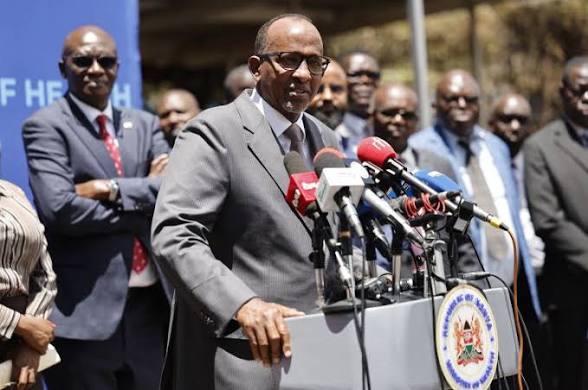
Health Cabinet Secretary Aden Duale has sought to reassure the public, stressing that the confirmed case was imported and that Kenya is not experiencing an Ebola outbreak.
However, the case has exposed concerns about the limits of temperature screening, particularly where symptoms may be masked.
Kenyan health officials said the patient may have taken medication that suppressed his fever before being screened at JKIA. Uganda, meanwhile, said the man recorded a normal temperature when he underwent screening at Entebbe airport before his departure.
Ugandan authorities have maintained that the country remains Ebola-free after declaring an end to its own outbreak in July. Officials said the Kenyan patient spent less than 24 hours in Uganda and had a normal temperature when screened.
The episode has nevertheless prompted renewed scrutiny of regional screening systems.
Dr Dennis Miskellah, representing Kenya’s doctors' union, said he had observed lapses at several border points, including crossings involving Uganda and Tanzania, as well as at Kenya’s main airport.
“How could you have been sick for almost a month plus in DR Congo, come all the way to the country through not just any small border point, but the main entry point, the main gateway into the country and pass unnoticed?” Miskellah asked.
Kaseya also noted that temperature checks alone cannot reliably detect Ebola because medication can suppress fever and there is currently no rapid diagnostic testing available at border points.
The concerns come against the backdrop of a severe Ebola outbreak in the DRC. More than 8,300 cases have been reported, with more than 4,100 deaths recorded, making it one of the deadliest Ebola outbreaks in the country's history.
The outbreak involves the Bundibugyo Ebola virus, a relatively rare strain first identified in Uganda in 2007. Unlike the Zaire strain responsible for the major West African outbreak of 2014–2016, there is currently no approved vaccine or specific treatment for Bundibugyo Ebola, although clinical trials are under way.
The virus is primarily spread through direct contact with the bodily fluids of an infected person, particularly once symptoms have developed, or through contaminated materials and surfaces. Transmission can also occur through contact with the bodies of people who have died from the disease.
The current outbreak has been complicated by conflict, population movement, weak infrastructure, misinformation and difficulties accessing affected communities in eastern DRC. The disease also crossed into Uganda earlier this year, where about 20 people were treated before the country was declared Ebola-free.
Kenyan authorities have designated four major hospitals to manage suspected or confirmed Ebola cases, including The Nairobi Hospital, where the first patient was treated.
The government is also revisiting plans for an infectious disease facility in Laikipia after an earlier proposal to establish a US-linked Ebola treatment centre at a military base in Nanyuki was halted by the courts following public opposition.
Duale said the government was considering converting the facility into a broader infectious disease hospital capable of responding to outbreaks such as Ebola.
Meanwhile, WHO Regional Director for Africa Mohamed Janabi said Kenya's existing preparedness systems had given the country an important advantage in responding to the imported case.
“Kenya has put important outbreak control measures in place. The priority now is to move swiftly to detect any further cases before the virus has an opportunity to spread,” Janabi said.
As health teams enter the critical monitoring period for people who may have been exposed, authorities are urging Kenyans to remain vigilant without panicking.
The Ministry of Health has advised the public to rely on official information, observe good hygiene and avoid contact with bodily fluids or contaminated materials from suspected cases. Health officials have also urged the public to avoid handling or washing bodies of people who die from unexplained illnesses, with suspected Ebola deaths subjected to supervised safe and dignified burial procedures.
For Kenya, the immediate challenge is no longer simply detecting a single imported case, but ensuring that the country's surveillance network can identify any possible secondary transmission before it develops into a wider outbreak.

Comments (0)
No comments yet. Be the first to comment!