

-
 ZELENSKYY FLAGS KENYA TO UN OVER RUSSIA WAR RECRUITMENT
-
 IRAN-US LOCK HORNS AT UNGA
-
 UHURU BACK ON 2027 POLITICAL FRONTLINE AFTER COURT RULING
-
 KAIKAI DISPUTES OMBIJA’S CLAIM GACHAGUA SOUGHT HIS SACKING
-
 NOLLYWOOD ICON OLU JACOB DIES AT 84
-
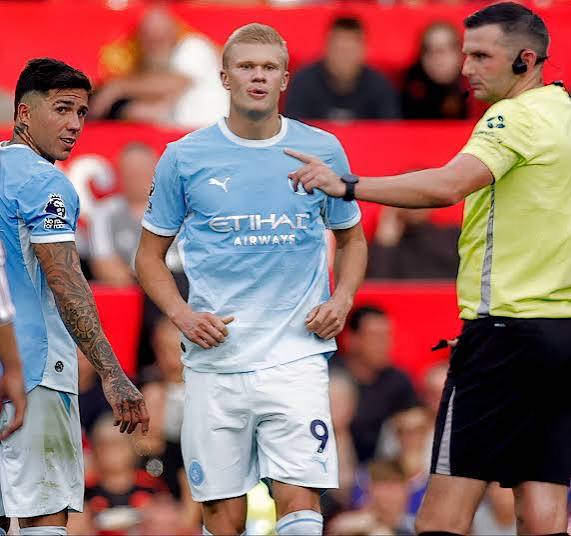 VAR OFFICIALS PUNISHED FOR HAALAND'S CONTROVERSIAL GOAL
-
 'FAKE JOMO ' DECLARES 2027 PRESIDENTIAL BID
-
 DIAMOND AND ZUCHU INTRODUCE BABY SANDRAH
-
 KENYA FLAGGED OVER AI MISUSE IN POLITICAL PROPAGANDA
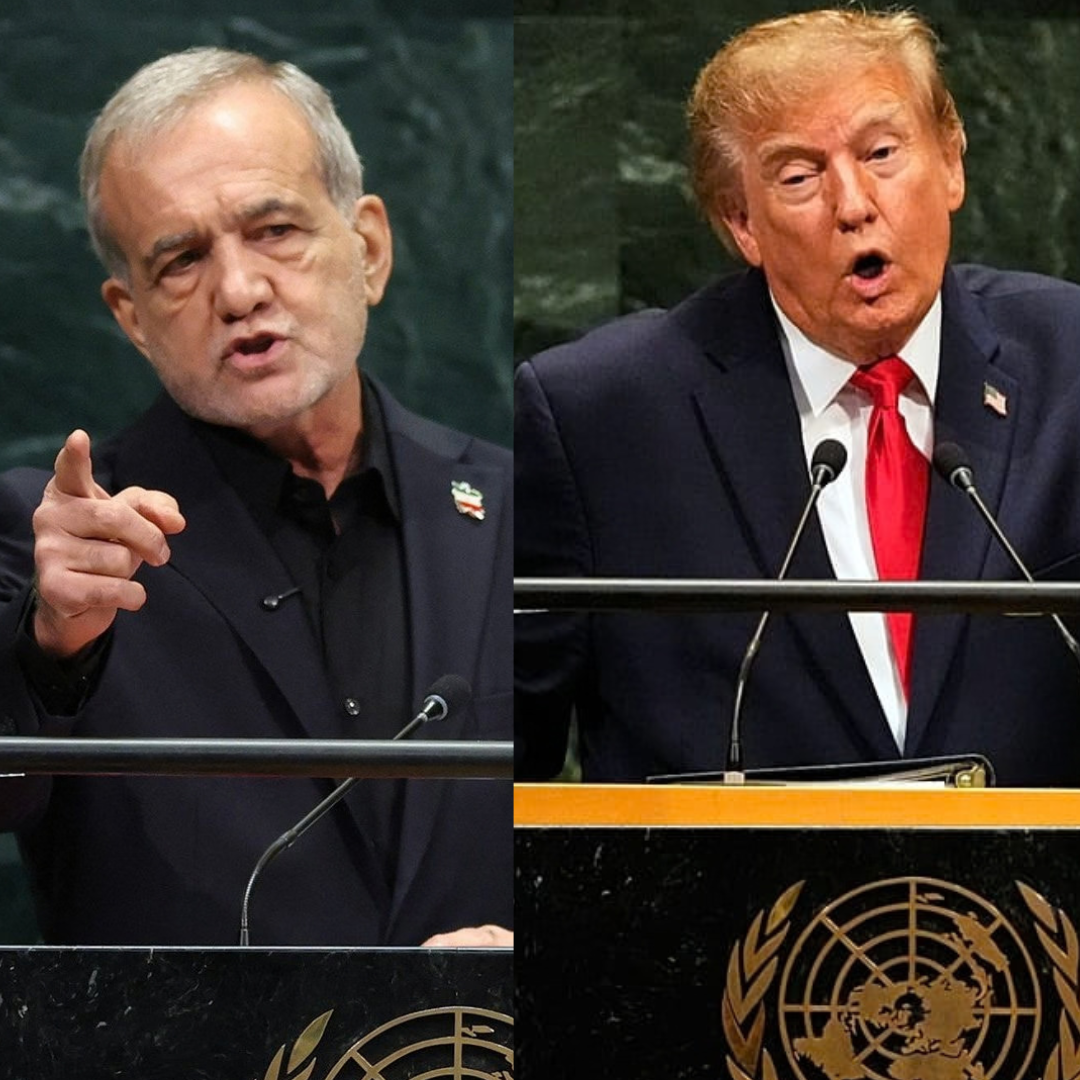
IRAN-US LOCK HORNS AT UNGA
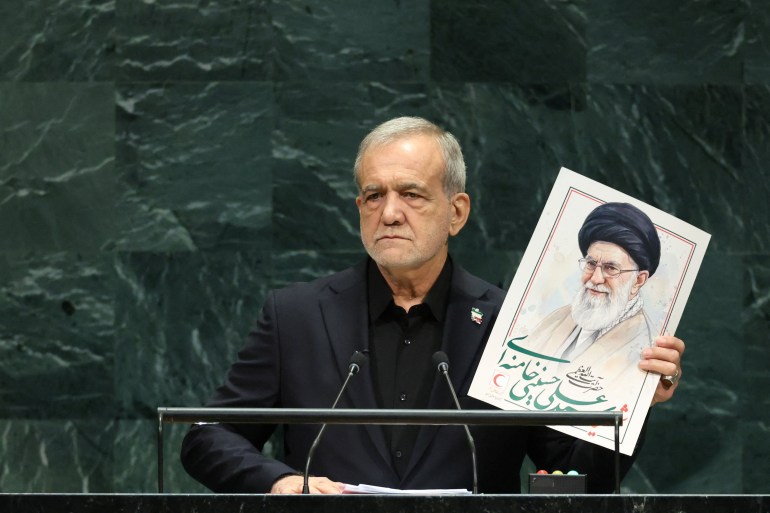
Iranian President Masoud Pezeshkian has rejected U.S. President Donald Trump’s threat to “annihilate” the Islamic Republic, telling the United Nations that Tehran remains open to diplomacy but will not negotiate under military pressure.
The confrontation unfolded at the 81st United Nations General Assembly in New York, where Trump and Pezeshkian addressed the same gathering a day apart as the nearly seven-month war between the United States, Israel and Iran continued to disrupt the Middle East.
Trump, speaking on Tuesday, September 22, framed the conflict as a choice between a negotiated settlement and further destruction.
“Will a deal be made with Iran that lets them rebuild and create a far greater country than it ever was before? Or do I annihilate the Islamic republic and do it quickly, never giving them a chance to kill and destroy people and drive them into hell with no chance of survival?” Trump said.
Pezeshkian answered from the same podium the following day with a message of defiance.
“The resistance of the Iranian people will only increase in the face of sanctions, increased pressure, increased bullying,” he said.
“We will never bow our head or bend at the knee.”
But the Iranian president did not close the door on negotiations. Instead, he drew a line between diplomacy and what Tehran regards as coercion.
“It must be understood by Mr. Trump and those who seek to bully us that we are ready for dialogue and diplomacy and negotiations without accepting the language of force.”
The exchange at the UN is the latest chapter in a conflict that began with escalating disagreements over Iran’s nuclear programme and a breakdown in diplomatic efforts.
The United States and Israel launched major military operations against Iran in February, with Washington arguing that military action was necessary to prevent Tehran from acquiring a nuclear weapon.
Iran rejected that justification, maintaining that its nuclear programme is intended for peaceful purposes and accusing Washington and Israel of attacking its sovereignty.
The fighting quickly expanded beyond Iranian territory. Iran retaliated with missile and drone attacks against Israel and locations in the Gulf hosting U.S. military forces, while the wider conflict affected Lebanon, Yemen and key shipping routes.
The war has since developed into a broader regional crisis, with commercial shipping disrupted and energy markets exposed to renewed uncertainty.
Pezeshkian used his UN address to present Iran as the country under attack rather than the aggressor.
“The US president described us as terrorists. We have been the victims of terrorism,” he said.
He displayed photographs of the late Supreme Leader Ayatollah Ali Khamenei and civilian victims of the war, including children whom Iranian authorities say were killed in an attack on a school in Minab.
“Our innocent people have been the targets of cowardly attacks and aggressions imposed on our country. And we defended ourselves with utmost strength,” Pezeshkian said.
Iran has blamed the United States and Israel for the civilian deaths, while Washington has disputed responsibility for some of the incidents cited by Tehran.
Diplomacy has repeatedly offered an alternative to the fighting, but previous attempts have failed to produce a lasting agreement.
A ceasefire and preliminary understanding reached in June briefly raised hopes that the war could be brought to an end and the Strait of Hormuz reopened.
The arrangement later collapsed, with disagreements over shipping, military operations, Iran’s nuclear programme and the conditions for lifting economic pressure returning the two sides to confrontation.
By September, Washington had maintained its blockade of Iranian ports while Tehran continued to exert pressure around the Strait of Hormuz.
That history has made the latest UN contacts particularly significant — but neither side has indicated that a breakthrough has been achieved.
On the sidelines of the General Assembly, U.S. envoy Steve Witkoff and Iranian Foreign Minister Abbas Araghchi took part in mediated discussions involving Qatar.
Trump described the roughly three-hour engagement as a “very good meeting” and said another meeting was expected.
Witkoff similarly expressed optimism about the discussions.
Iran, however, played down the significance of the contact and stressed that its conditions had not changed.
The Iranian side has demanded an end to the U.S. blockade, the release of frozen Iranian assets and an easing of military pressure.
Tehran had already sent a proposal through mediators on September 16 and said the UN gathering offered an opportunity to revive diplomacy if Washington was prepared to take concrete steps.
The Strait of Hormuz has emerged as one of the most important issues in the negotiations.
The strategic waterway is a major route for international energy shipments, meaning its disruption has consequences far beyond Iran and the United States.
Iran has said it could reopen the strait if Washington eases military pressure and lifts its blockade.
Pezeshkian raised the issue directly at the UN.
“It cannot be the case that everyone benefits from the Strait of Hormuz while we are denied access,” he said.
Washington, however, has demanded that Iran restore freedom of navigation and reach an agreement addressing its nuclear programme and wider security concerns.
The standoff has already contributed to volatility in global energy markets, while attacks and restrictions around the waterway have raised concerns over the safety of commercial vessels.
The economic repercussions are being felt beyond the battlefield, with higher energy and shipping costs threatening countries that depend heavily on imported fuel.
The hostility between the two governments was impossible to miss inside the General Assembly hall.
Iran's delegation walked out during Trump's address, while a U.S. representative and members of the Israeli delegation left the chamber when Pezeshkian began speaking.
The walkouts reflected the depth of the political divide at a gathering whose central purpose is to provide a forum for dialogue between states.
Pezeshkian used his appearance to accuse Washington of undermining the principles of the UN and criticised what he called international double standards.
He argued that Iran was being pressured over its nuclear programme while Israel possesses nuclear capabilities and has not faced comparable restrictions.
He also maintained that Iran would not surrender its civilian nuclear programme.
“We say it clearly: No nuclear weapons and no limitations to peaceful nuclear technology,” Pezeshkian said.
The United States, meanwhile, continues to argue that Iran must accept restrictions sufficient to prevent it from developing a nuclear weapon.
The crisis has also featured in the wider diplomatic debate at the UN, including Kenya's intervention.
President William Ruto used his address to challenge the structure of the international system, arguing that the current UN Security Council does not adequately represent today's world.
His remarks came as the Iran war provided a backdrop to wider questions about the effectiveness of international institutions in preventing and resolving conflicts.
Ruto renewed Kenya's call for permanent African representation on the Security Council, pointing out that the continent's 54 countries have no permanent seat despite making up more than a quarter of the General Assembly.
“Africa has 54 member states, more than a quarter of this assembly, yet no permanent voice in the body entrusted with the primary responsibility for international peace and security,” Ruto said.
He added that Africa was “frequently the subject of its decisions, permanently discussed, yet permanently excluded.”
Ruto also warned against selective application of international law.
“International law cannot be invoked loudly in one crisis, cautiously in another crisis, and disregarded when convenient,” he said.
His argument fits into Kenya's broader diplomatic position of supporting multilateralism and greater representation for developing countries in global decision-making.
Kenya's Foreign Affairs Ministry had earlier described UNGA 81 as an opportunity for Nairobi to contribute to discussions on international security while advancing its wider diplomatic and economic interests.
The latest exchange at the UN leaves Washington and Tehran facing two very different public positions.
Trump says Iran must make a deal and has threatened devastating consequences if it does not.
Pezeshkian says Iran is willing to negotiate but refuses to do so under what he calls the “language of force.”
At the same time, the two countries are still communicating through intermediaries, particularly Qatar, while the Strait of Hormuz remains at the centre of efforts to find a way out.
Whether that opening is enough to produce another ceasefire, reopen the Strait of Hormuz and eventually end the war remains the central question hanging over the UN General Assembly.
Comments (0)
No comments yet. Be the first to comment!