

-
 SIFUNA TO QUIT SG ROLE UNDER ONE CONDITION
-
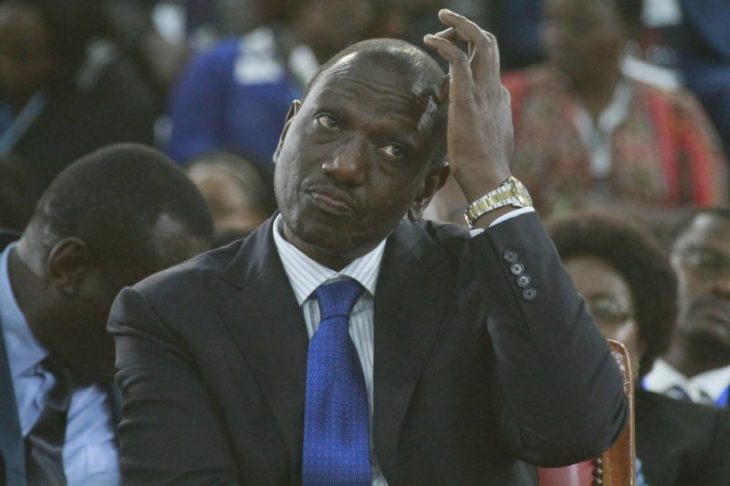 RUTO'S HEADACHE AS COURT DECLARES CABINET UNCONSTITUTIONAL
-
 TRUMP SKIPS WORLD CUP SPOTLIGHT
-
Martha Karua Denied Entry Into Uganda Amid Growing Concerns Over Opposition Legal Cases
-
Justice Gatembu Kairu Elected New President of the Court of Appeal
-
 NADIA FIRES BACK AT TROLLS OVER ARROW BWOY'S RING DEFEAT
-
 FINANCE BILL 2026 SAILS THROUGH AS 55% OF MPs SNUB VOTE.
-
 Emerging Leaders Foundation Calls for Performance-Based Public Service Reforms at National Productivity Conference
-
 IRANIAN TEAM LAMENTS 'OPPRESSION' AFTER US EXIT ORDER AMID WORLD CUP
RUTO'S HEADACHE AS COURT DECLARES CABINET UNCONSTITUTIONAL
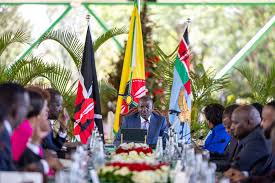
President William Ruto has suffered a major legal setback after the High Court declared the current composition of his Cabinet unconstitutional, ordering him to reconstitute it within the next 120 days to comply with the Constitution's two-thirds gender rule.
The landmark ruling, delivered on Tuesday by a three-judge bench, places fresh pressure on the Kenya Kwanza administration and reignites a constitutional debate that has followed President Ruto's Cabinet appointments since he first assumed office.
Issuing the judgment, Justice Eric Ogola directed the Head of State to ensure future Cabinet appointments comply with Article 27(8) of the Constitution, which requires that no more than two-thirds of members of an appointive public body be of the same gender.
"The appointing authority, being the President, is hereby directed to make appointments for Cabinet Secretaries in conformity with Article 27(8) within 120 days from the date of this judgment," Justice Ogola ruled.
The court noted that the Cabinet consists of 25 members comprising the President, Deputy President, Attorney General and Cabinet Secretaries. However, they ruled that the Secretary to the Cabinet is not a Cabinet member under Article 152(1) of the Constitution and therefore cannot be included when determining whether the Executive satisfies constitutional requirements on gender representation.
As per the readings, the current Cabinet comprises 18 men and seven women, leaving women with only about 28 per cent representation. The judges held that in a 25-member Cabinet, at least nine positions should be occupied by the underrepresented gender to satisfy the constitutional threshold.
Consequently, the bench declared that the Cabinet, as presently constituted, violates Articles 10 and 27 of the Constitution.
The ruling marks the latest chapter in a constitutional question that has lingered for years. Legal scholars and constitutional experts had previously argued that President Ruto's Cabinet failed to meet the two-thirds gender requirement from the time it was first unveiled, maintaining that only offices expressly recognised by the Constitution could be counted in calculating gender balance.
The court echoed that position by rejecting any attempt to include the Secretary to the Cabinet in the constitutional arithmetic, reinforcing the view that the composition of Cabinet must strictly follow the framework set out in the Constitution.
Despite finding the Cabinet unconstitutional, the judges declined to invalidate the appointments of Cabinet Secretaries who were reappointed after President Ruto dissolved his entire Cabinet in July 2024 following the nationwide Gen Z-led anti-government protests.
The petitioners had argued that bringing back some of the same ministers defeated the purpose of dissolving the Cabinet, a move that had been presented as a response to growing public anger over governance, accountability and integrity.
However, the court held that the Constitution does not bar a former Cabinet Secretary from returning to office after dismissal.
"The text does not prescribe that dismissal under that article creates a permanent or temporary disqualification from future appointments," the judges ruled while interpreting Article 152.
The bench further explained that there is a clear distinction between a general political dismissal and removal from office for violating Chapter Six of the Constitution on leadership and integrity.
"A general dismissal under Article 152(5)(b) is not the same thing as removal for contravention of Chapter Six," Justice Ogola stated.
While acknowledging that reappointing ministers after dissolving the Cabinet could raise political questions, the judges stressed that their responsibility was to determine whether the appointments were constitutional rather than whether they were politically prudent.
"The court is not called upon to determine whether the decision to return some former Cabinet Secretaries was politically persuasive or administratively wise. Rather, the court is called upon to determine whether the Constitution prohibited their nomination and appointment," the bench said.
The judges also dismissed attempts to challenge the legality of President Ruto's broad-based government, ruling that the Constitution does not prohibit the appointment of politicians drawn from opposition parties, provided all constitutional procedures and standards are followed.
That finding effectively upholds the President's decision to bring several opposition leaders into government following the 2024 Cabinet reorganisation. The appointments included John Mbadi, Hassan Joho, Opiyo Wandayi, Wycliffe Oparanya and Beatrice Askul as Cabinet Secretaries, while Dorcas Oduor was appointed Attorney General.
Even so, the court cautioned that political inclusivity cannot be used to excuse failure to comply with constitutional requirements relating to gender representation and accountability.
Although the ruling is a significant legal blow to the President, it does not immediately invalidate the Cabinet or halt government operations. Instead, the court granted President Ruto a 120-day window to rectify the constitutional breach by making appointments that satisfy the gender rule.
The judgment is also expected to fuel wider debate over constitutional governance and the implementation of the two-thirds gender principle, an issue that has repeatedly found its way into Kenya's courts over the years.
It also comes only weeks after another High Court bench nullified former Chief Justice David Maraga's 2020 advisory that had recommended the dissolution of Parliament over its failure to implement the same constitutional gender requirement, underscoring the Judiciary's continuing role in defining how the principle should be applied.
Beyond the courtroom, the decision has triggered intense political discussion across the country. Supporters of the judgment have welcomed it as a reaffirmation of constitutional supremacy and judicial independence, arguing that all State appointments must comply with the Constitution regardless of political considerations.
Government allies, however, have maintained that the administration acted within the law and are widely expected to challenge the decision through the appellate courts.
With an appeal likely and the 120-day deadline already running, attention now shifts to how President Ruto will respond. Whether through a Cabinet reshuffle or fresh appointments, the Head of State now faces the task of bringing his Cabinet into line with the Constitution while preserving the political balance of his broad-based administration.
Comments (0)
No comments yet. Be the first to comment!